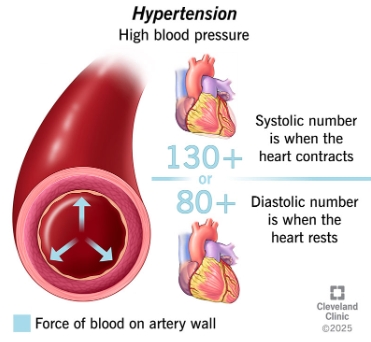
Hypertension, or high blood pressure, means the force of blood pushing against your artery walls is too high. This makes your heart work harder to pump blood through your body. Over time, hypertension damages your arteries and heart. It can lead to serious complications, like a heart attack or stroke. Because high blood pressure usually doesn’t cause symptoms, it’s often known as a “silent killer.”
Healthcare providers measure blood pressure (BP) in millimeters of mercury (mmHg). Your reading has two numbers:
Systolic blood pressure: This is the top number. It’s the pressure on your artery walls when your heart contracts.
Diastolic blood pressure: This is the bottom number. It’s the pressure between beats when your heart relaxes.
What’s considered high blood pressure varies slightly based on where you live. In the U.S., healthcare providers define it as:
A top number (systolic BP) of 130 mmHg or higher, OR
A bottom number (diastolic BP) of 80 mmHg or higher
In Europe, providers define hypertension as a top number of 140 or higher, or a bottom number of 90 or higher.
High blood pressure is very common. It affects nearly half of all adults in the U.S. It’s a major risk factor for cardiovascular disease.
Source: https://my.clevelandclinic.org/health/diseases/4314-hypertension-high-blood-pressure